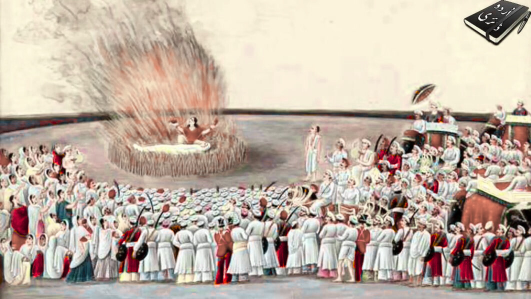
The word 'Sati' originates from the Hindu Goddess Sati, who immolated herself in a sacrificial fire after being humiliated at her paternal residence for marrying a man against her father Daksha's will. This origin of Sati dates back to ancient times, when it was firmly believed to be a voluntary act, signifying a woman's ardent devotion towards her husband. The women who performed this tragic act were idealised and glorified in their community but it was ultimately a woman's choice to perform it.
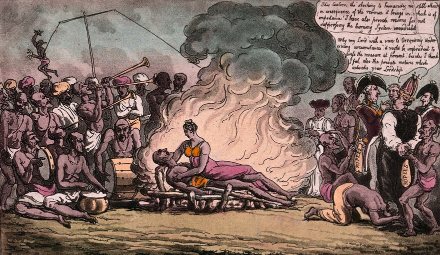
While ancient Indian scriptures consist of quite a few examples of Sati, like the monumental Hindu epic of Mahabharata, which mentions the self-immolation of Madri (King Pandu's wife), there also have been records of widows living a restrictive lifestyle or remarrying someone and creating a new family post their husband's demise, depending on the exact aeon and geographical location they lived in. The culture of Sati became rampant in the early medieval times, especially among the Rajputs, a new Kshatriya caste which had mysteriously grown to power and significance. The major cause of a rising trend in Sati was due to the Rajput customs which were extremely oriented with valorous acts and ideas. They believed that men's duty was to sacrifice their lives protecting the honour of their motherland and women's duty was to protect the honour of their family and society by immolating themselves on their husbands' pyres. The rise of Islamic rulers and their malicious intent with regards to the spouses of the men they had defeated in the line of war further instated the social order to pressurise widows to commit Sati in order to protect their chastity. A large-scale performance of Sati, especially by women of a defeated kingdom, was prevalent in many Rajput kingdoms, known as Jauhar.
The most renowned of Jauhars was the first Jauhar of Chittor after the defeat of Raja Rawal Ratan Singh by Ala-ud-Din Khalji of the Delhi Sultanate.

The culture of Sati was mostly restricted to the Kshatriyas and was not generally practiced by Brahmins, Vaishyas or Shudras. The reason of this social regulation can be linked to the fact that the wives of the defeated Kshatriyas, the martial community, were the main preys of the enemy rulers.
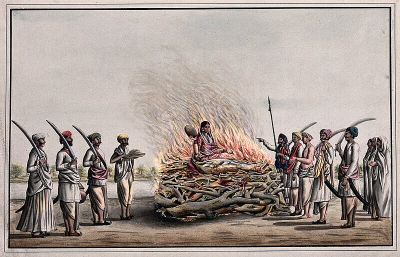
In the early epochs, the Brahmins of Kashmir and the northern realms refrained from this rite, untouched by the flames that later marked the passage of widowed fate, because it did not have any significance in the 'Vedas' or the 'Bhagavad Gita'. However, this practice later gained traction throughout India. By the 17th century, it had largely declined, but it experienced a sudden resurgence in Bengal during the 18th century. The cases of Sati surged from 378 to 839 during the colonial rule. The dark and heinous reason behind this increase was to exclude women from the inheritance of property.
In 1829, reformers like Lord William Bentinck, the then Governor-General of India, sought the opinions of forty-nine senior army officers and five judges before banning Sati. The regulation described Sati as 'revolting to the feelings of human nature' and 'unlawful and wicked', reflecting the judiciary's strong condemnation of the practice. The Privy Council, the highest court of appeal in British India, upheld the ban in 1832, calling Sati a 'flagrant offence against society'.
Academicians highlight that reformers like Raja Ram Mohan Roy, Rani Rashmoni, and Sahajanand Swami argued against the practice of Sati, stating it had no Vedic sanction and was not a religious duty. Women also actively revolted against the heinous rite. Ultimately, the enactment of The Commission of Sati (Prevention) Act, 1987, by the Indian Parliament, reflected the state's stance against Sati, referring to it as a criminal act and its glorification to be punishable by law.
In the pages of history, a woman walks into fire not by faith but by force disguised as tradition. Law drew its line, truth found its voice, and the flames that once silenced became symbols of resistance. Sati is a gruesome chapter in Indian history, condemned by law, reformers, and the conscience of modern society. It is not a prayer, not a path to divinity—it's a wound now named, and condemned, never to be honoured as anything but a wound upon the soul of truth.
“The greatest injury to women arose from theological laws that subjugated women to men.”